Key Findings
Open interest share remained stable. Across the five major exchanges, Binance’s share of derivatives open interest was 44.9% in the 30 days before the incident and 43.8% in the two weeks after, a change of about 1.1 percentage points.
Order book depth share held steady. Binance’s share of ±1% depth across the three major exchanges was around 55% both before and after the incident; it stood at 52.0% about 20 hours before the hack and 52.5% about 4 hours after.
Derivatives volume share was essentially unchanged. Binance’s share of derivatives trading volume across the five major exchanges was 51.2% in the two weeks after the incident, against 51.3% in the 30 days before; during the withdrawal suspension it was 50.9%.
1. Event Overview
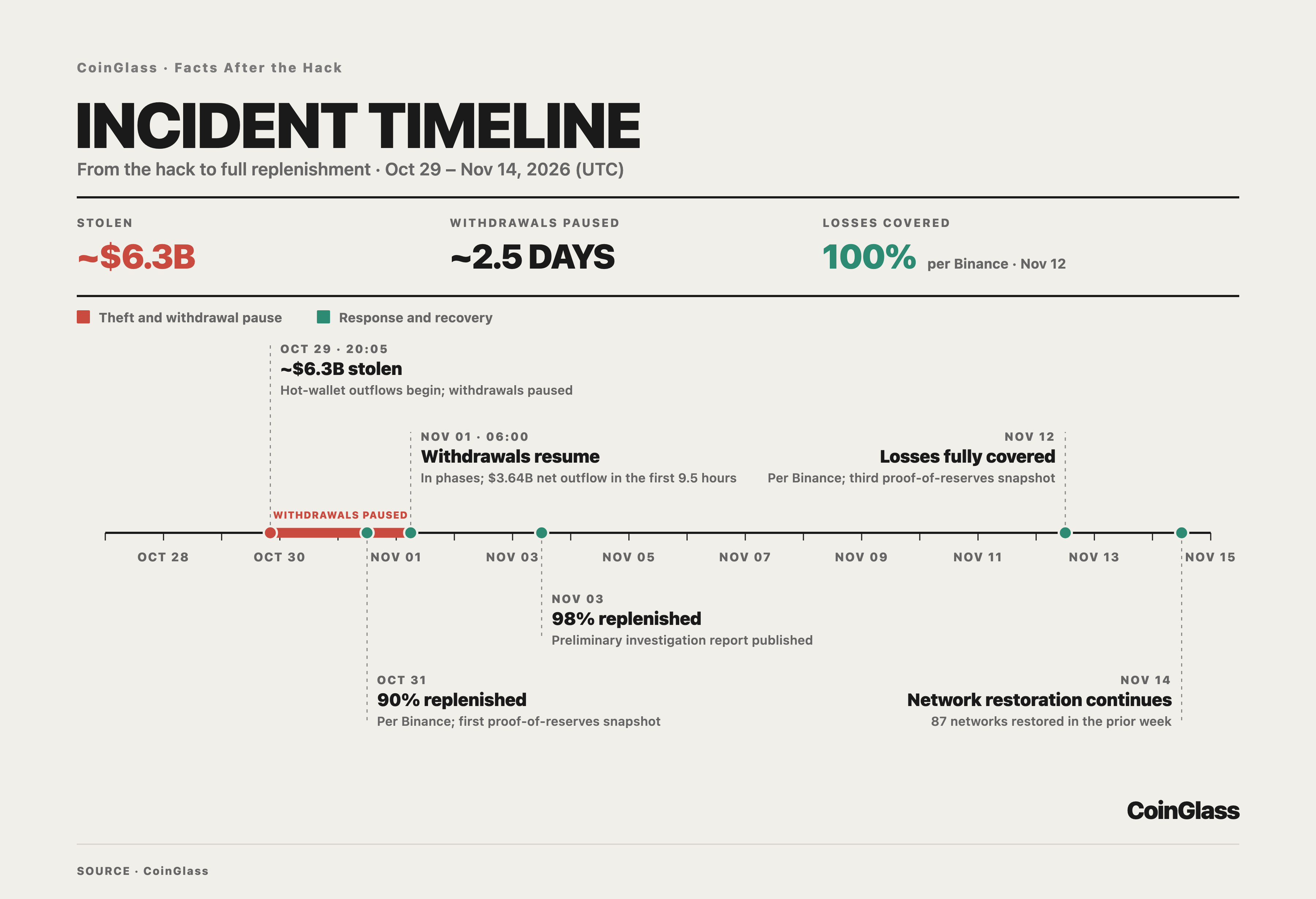
Beginning at 20:05 UTC on October 29, 2026, assets were moved out of Binance’s hot wallets on multiple chains; publicly reported losses amount to approximately $6.3 billion. Binance suspended withdrawals that evening and began restoring them in phases at 06:00 UTC on November 1, a suspension of about two and a half days. According to Binance, the losses were borne by the platform and the stolen assets were fully replenished on November 12 (Figure 1).
2. Methodology
Beyond the platform’s own disclosures, the operating condition of an exchange after a security incident can also be judged from the actual behavior of market participants. This report examines the latter through three indicators: derivatives open interest, to observe whether leveraged traders kept their positions; order book depth, to observe whether market makers continued to provide liquidity; and derivatives volume share, to observe whether trading activity continued.
The sample period runs from September 29 to November 18, 2026. The 30 days before the incident (September 29 to October 28) serve as the baseline, and “the two weeks after the incident” refers to October 30 to November 12. Since the incident, the price of BTC has fallen by about 20%, and open interest and resting orders have contracted across exchanges, so changes in absolute values cannot separate market factors from the effect of the incident. This report therefore uses Binance’s share among major exchanges throughout.
3. Open Interest Share
Open interest corresponds to margin that traders keep on the platform, and positions can be closed at short notice, so changes in its share reflect how traders view platform risk. This report measures it as Binance’s share of derivatives open interest across five exchanges: the top five by derivatives trading volume in CoinGlass’s report for the first half of 2026, namely Binance, OKX, Bybit, Gate and Bitget.
In the 30 days before the incident, Binance’s share averaged 44.9%, with daily values between 44.2% and 45.7%. The share was 45.2% about 20 hours before the hack and 44.1% about 4 hours after. In the two weeks after the incident it averaged 43.8%, and in the most recent week (November 13 to 18) it was 43.7%, a change of about 1.1 percentage points from the pre-incident level (Figure 2).
The share has been edging lower since September: it was about 45.7% in early September and about 44.8% in the week before the incident. By asset, the change came mainly from BTC contracts, where Binance’s share was 42.6% before the incident and 40.1% in the two weeks after; its shares in ETH and other contracts changed by less than 1 percentage point.
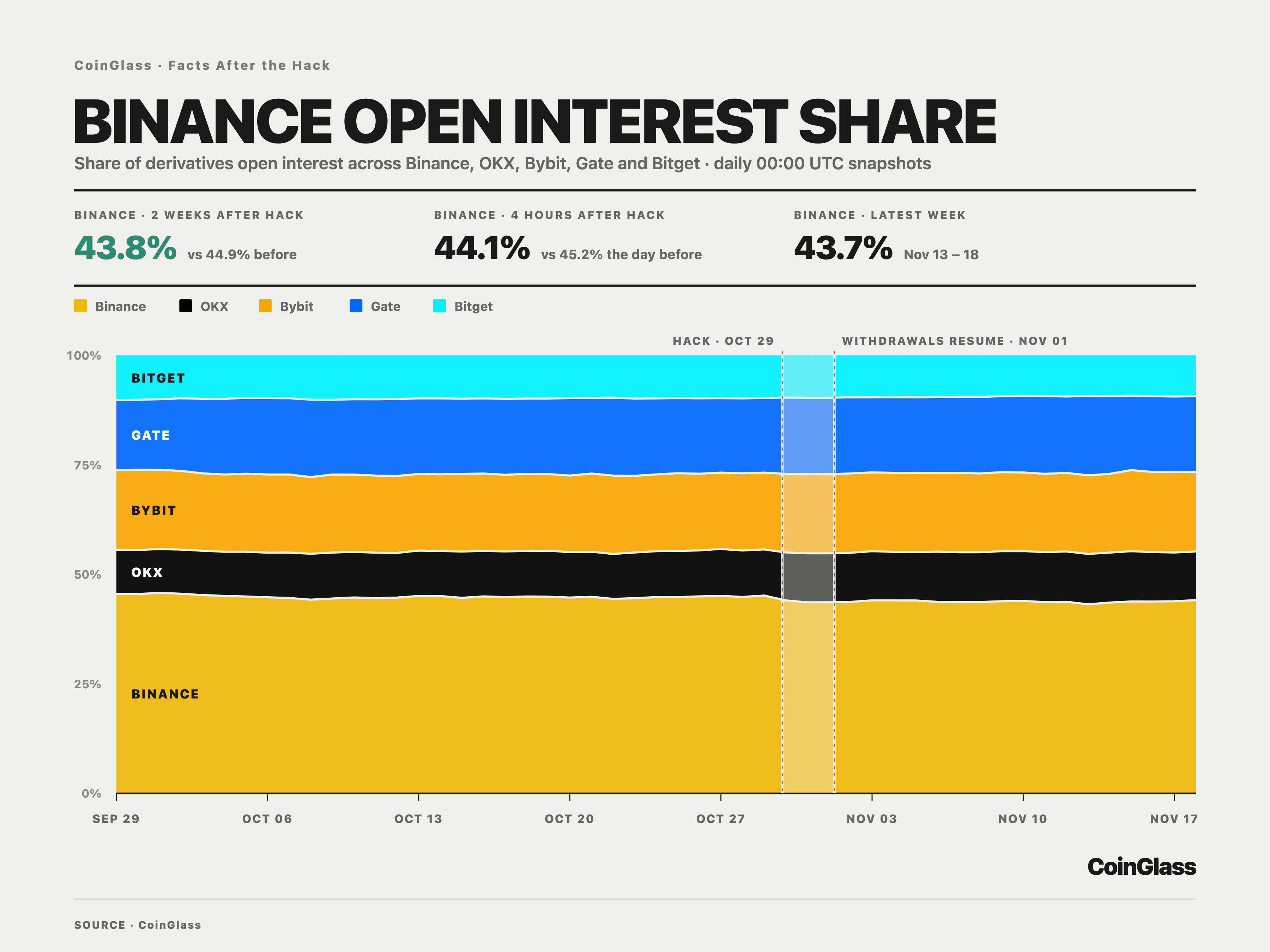
Binance’s share of derivatives open interest moved from 44.9% before the incident to 43.8% in the two weeks after, a change of about 1.1 percentage points that came mainly from BTC contracts. The open interest data show that the vast majority of positions stayed on Binance and that its share remained stable.
4. Order Book Depth Share
Market makers quote with their own capital and bear platform risk. Cancelling orders does not depend on withdrawals and can be done at any time, so changes in quoted size reflect, to some extent, their assessment of platform risk. This report measures depth as the value of bids and asks within 1% of the mid price, across the three centralized exchanges with complete order book data: Binance, OKX and Bybit.
About 4 hours after the hack, Binance’s futures depth was down 21% from the previous day, while the three exchanges combined were down 22%. Binance’s decline was in line with the market as a whole, and the data show no sign of market makers pulling quotes from Binance specifically. Binance’s share of the three exchanges’ combined depth was 52.0% about 20 hours before the hack and 52.5% about 4 hours after.
In the two weeks after the incident, Binance’s share of futures depth averaged 55.0%, against 55.3% before; its share of spot depth averaged 55.0%, against 54.3% before (Figure 3). Both shares moved by less than 1 percentage point.
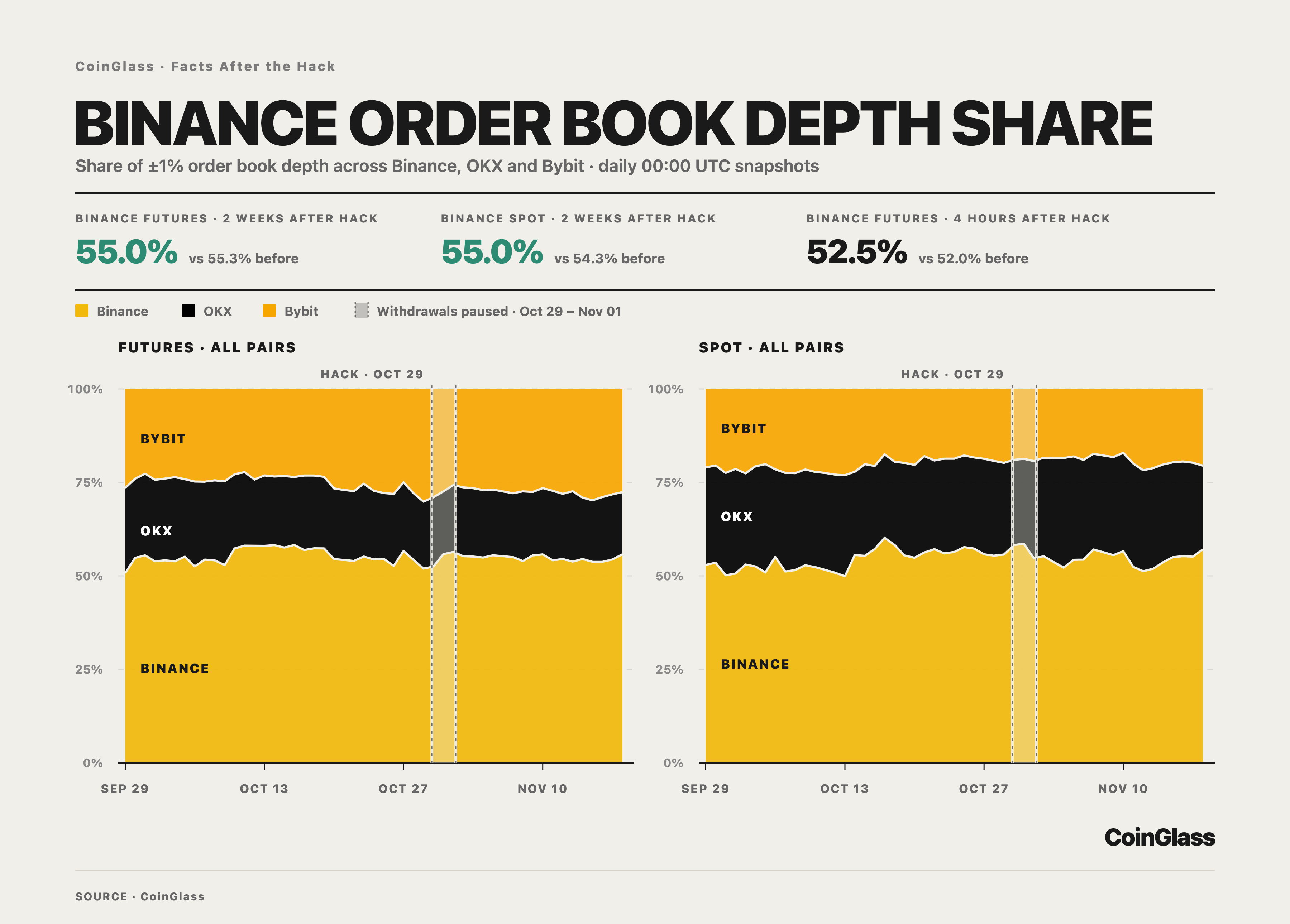
Both in the hours after the hack and over the following two weeks, Binance’s share of order book depth stayed close to its pre-incident level. The order book data show that the relative scale of liquidity that market makers provide on Binance did not change materially as a result of the incident.
5. Derivatives Volume Share
Trading volume shows whether traders continued to trade on the platform. Unlike open interest and order book depth, volume is a flow accumulated over the whole day and is not affected by fluctuations at any single moment. This report measures it as Binance’s share of derivatives trading volume across the five exchanges, the same scope as for open interest. The share for each period is weighted by trading volume within that period.
In the 30 days before the incident, Binance’s share was 51.3%, with daily values between 47.3% and 53.0%. It was 50.9% during the withdrawal suspension (October 30 to November 1), 51.2% in the two weeks after the incident and 50.2% in the most recent week (November 13 to 17), all within the pre-incident range of daily values (Figure 4).
By asset, Binance’s share in BTC contracts was 41.8% after withdrawals resumed (November 2 to 12), against 44.7% before the incident; its shares in ETH and other contracts changed by less than 1 percentage point. In addition, during the withdrawal suspension the daily closing price of BTC/USDT on Binance deviated from other major exchanges by at most 6.8 basis points (0.07%), so prices on the platform remained in line with the market.
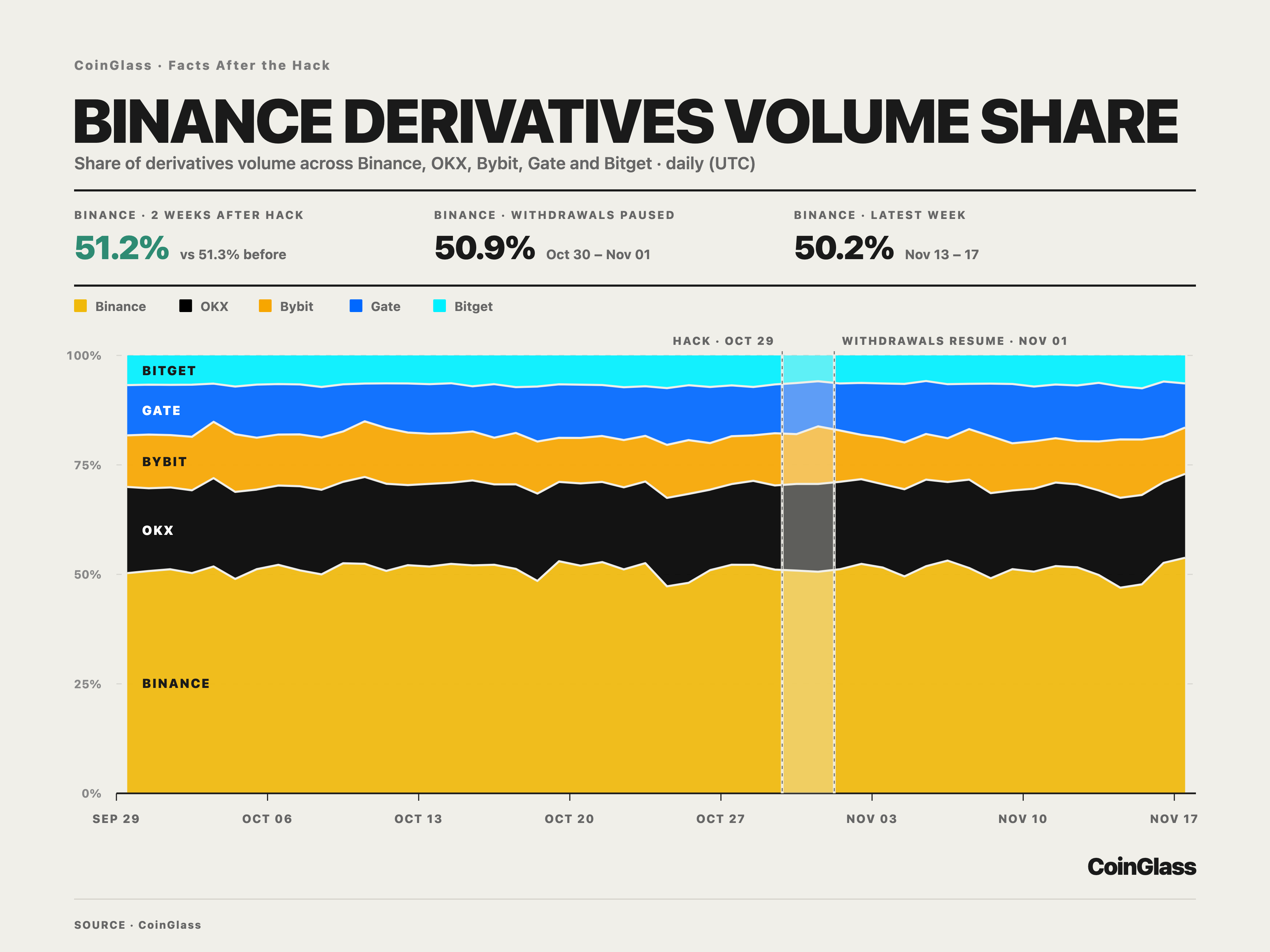
Binance’s share of derivatives trading volume across the five exchanges was essentially unchanged before and after the incident. The volume data show that trading activity on Binance remained stable; the share in BTC contracts declined somewhat.
6. Conclusion
The hack of October 29, 2026 caused an asset loss of approximately $6.3 billion and led to a withdrawal suspension of about two and a half days. Data from the three weeks since show that this shock has not materially changed Binance’s market position in trading, liquidity or open interest.
On trading activity, Binance’s share of derivatives trading volume across the five major exchanges was 51.2% in the two weeks after the incident, essentially the same as the 51.3% before it; even during the withdrawal suspension the share held at 50.9%. During the suspension, the price of BTC on the platform deviated from the market by no more than 0.07%, and trading and pricing remained orderly.
On liquidity, Binance’s share of order book depth was stable at around 55% before and after the incident. About 4 hours after the hack, with market depth contracting across the board, Binance’s share was 52.5%, comparable to the 52.0% before the hack; the data show no sign of market makers reducing their quotes on Binance specifically.
On open interest, Binance’s share of derivatives open interest across the five major exchanges was 43.8% in the two weeks after the incident, against 44.9% before, a change of about 1.1 percentage points; the vast majority of positions stayed on the platform.
On the response, withdrawals were restored in phases after a suspension of about two and a half days; according to Binance, the losses were borne entirely by the platform and the stolen assets were fully replenished on November 12.
The three indicators point to the same conclusion: under the shock of approximately $6.3 billion in stolen assets and a withdrawal suspension of about two and a half days, Binance’s trading volume, liquidity and open interest all remained stable. Traders continued to trade on the platform, market makers continued to quote, and Binance’s core business withstood the test of this incident.
Source: CoinGlass. Information on the incident is drawn from public reports and Binance’s disclosures.